Absorbent Socks vs Booms: Which Spill Control Solution Fits Your Site
Introduction
Absorbent socks and absorbent booms are the two primary containment products that turn a spreading spill into a manageable one. Socks are flexible tubes used on to land-based spills and around machinery; dry-land containment around a leaking drum, a service bay, or a workshop floor. Booms are longer, heavier containment barriers designed to float and to be deployed across open water to corral hydrocarbons, control surface slicks, or protect a shoreline. They look similar in cross-section, but the working conditions, the deployment method, and the buying decision are fundamentally different.
This guide is written for safety managers, EHS coordinators, and procurement officers who need to know when a socks is the correct product, when a boom is the correct product, and when a site should stock both. It is based on the published categories of SYVEA Industrial absorbent socks and absorbent booms, and on the way those products are deployed in real industrial and marine settings.
What an Absorbent Socks Actually Does
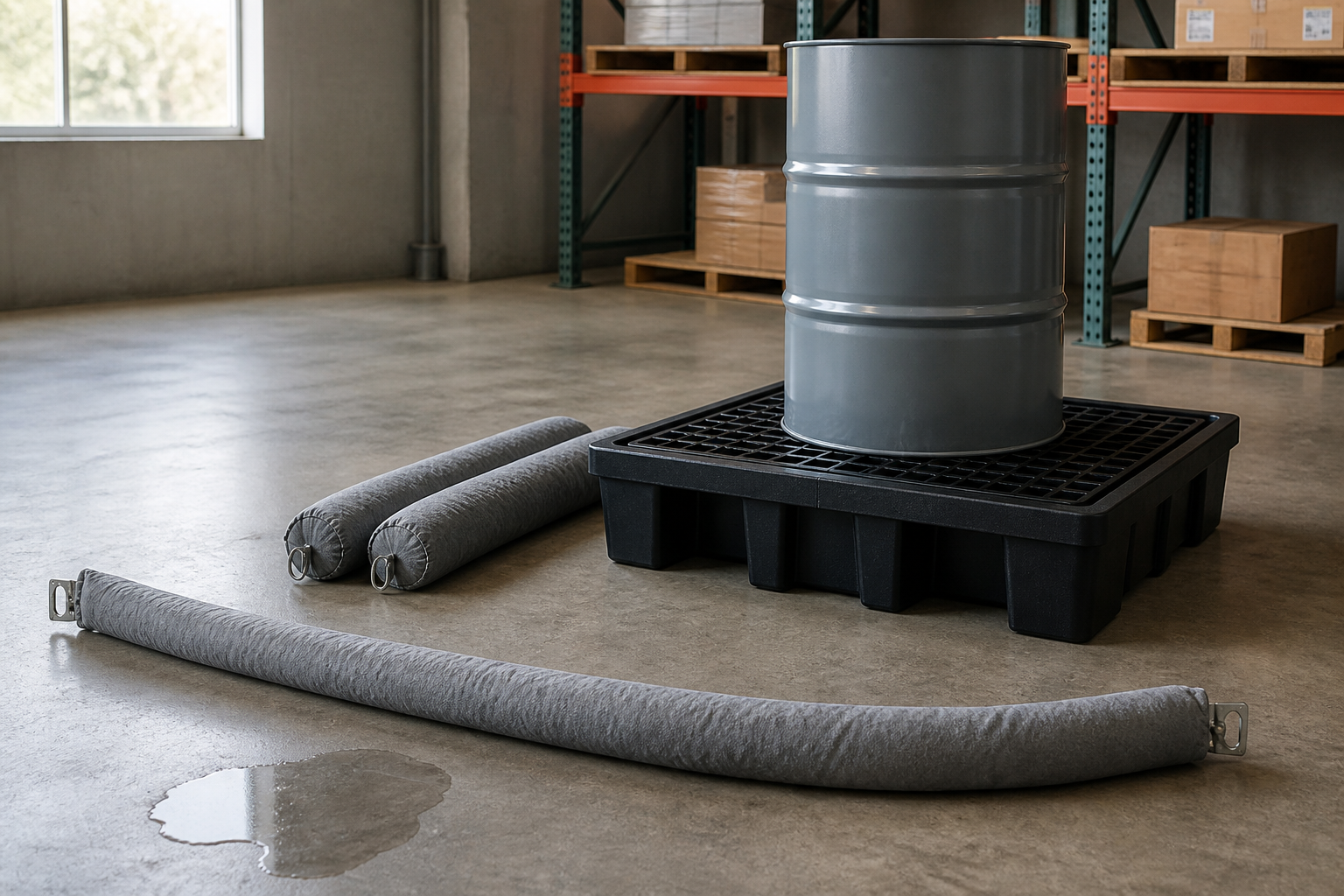
An absorbent socks is a flexible, tube-shaped absorbent that is laid on to a hard surface to dike and absorb a spill at the same time. The flexible skin lets the socks follow any perimeter: a drum, a pallet, the corner of a service pit, the edge of a machine bay. Socks can be shaped around obstacles, stepped over by staff, and repositioned mid-cleanup without breaking. SYVEA Industrial publishes the absorbent socks product line as a standalone category covering oil-only, universal, and chemical-resistant socks for facility use.
On hard surfaces, socks are usually the fastest and most controllable containment option. They are light enough to be carried one-handed, they stay where they are placed, and they absorb the liquid they are containing instead of only damming it. Most facility-scale spill response plans treat absorbent socks as the first line of containment, before pads and pillows enter the picture.
What an Absorbent Boom Is Does
An absorbent boom is a longer, heavier, often rope-endowed containment barrier that is designed to float. Booms are deployed across the surface of open water or along a shoreline to contain and recover hydrocarbons, coolants, or other buoyant liquids. They are typically supplied in longer sections and are joined together with end connectors to form a continuous barrier across a waterway, a marina, or a dock face. SYVEA Industrial publishes the absorbent booms product line as a separate category for oil-spill response on water.
On water, a socks cannot do the work of a boom. A socks has no flotation, no connecting hardware, and no freeboard to push floating debris aside. A boom has a waterline collar, an outer skin that resists wave action, and a long continuous length that can be deployed quickly from a boat or a shoreline. Booms are also the right product when free oil needs to be corralled at speed across a wide surface, where rolling the product out section by section is faster and safer than laying individual socks.
The Core Comparison: Socks vs Booms at a Gl
The following table summarizes the practical differences between absorbent socks and absorbent booms. Use it as a quick reference when you are sizing a containment plan for a new site or a new operation.
| Attribute | Absorbent Socks | Absorbent Booms |
|---|---|---|
| Primary deployment surface | Hard floors, around machinery, drums, pallets | Open water, shorelines, dock faces |
| Typical form factor | Flexible, short tube, often 1.2 to 3 m sections | Long continuous barrier, often 3 to 10 m sections with end connectors |
| Flotation | None (sits on the floor) | Floats; designed to push surface liquid and debris |
| Containment vs absorption role | Both dikes and absorbs | Primary role is containment; absorption is secondary |
| Best liquid class | Oil, water, coolant, mild chemicals (depending on socks class) | Hydrocarbons, fuels, oils (oil-only class) |
| Typical deployment crew | One operator, hand carried | Two or more operators, often deployed from a boat |
| Repositioning mid-spill | Easy; flexible skin follows new perimeters | Difficult; sections are heavier and connector-dependent |
| Common SYVEA category | Absorbent Socks | Absorbent Booms |
Site-by-Site: When to Choose a Socks
Socks are the right answer in any environment that is indoors, on a hard floor, or around fixed equipment. The most common use cases are:
Around Drums, Totes, and IBCs
Place socks around the base of any container that holds oil, coolant, or chemicals. A leaking drum shows the leak at the seam or the valve, but the liquid spreads quickly across a containment pallet or the floor. Socks stop the spread inside the bunded area and absorb what is leaking, which keeps the secondary containment from overflowing.
Around Machine Bays and Service Pits
Workshops, forklift bays, and vehicle service pits are routine drip points. A row of socks along the edge of the bay catches drips before they reach walkways, and a sock across the low point of the floor channels the liquid into a controlled cleanup rather than a spreading stain.
Indoor Spill Entrances and Aisles
Socks laid across the bottom of a doorway or across a corridor contain a spill to one room while staff set up the rest of the response. They are also used to mark the boundary of an exclusion zone during a chemical cleanup, when staff should not step through the area until absorbents are in place.
Inside Spill Kits
Most pre-assembled spill kits include socks as part of the standard content. They are the first item deployed after the operator arrives, and they are what allows pads to work on a confined pool of liquid rather than a spreading one. For a full kit checklist, see our guide on the warehouse spill kit checklist.
Site-by-Site: When to Choose a Boom
Booms are the right answer whenever the spill is on water, on a shoreline, or across a large open surface where a continuous barrier is faster than laying individual socks.
Open-Water Oil Spills
When a fuel tank, a hydraulic line, or a transfer hose fails on a vessel or at a dock, free oil spreads across the water surface in minutes. Booms are deployed from a boat or from the dock to encircle the slick and pull it toward a recovery point, where skimmers or absorbent pads pick up the pooled liquid. Socks cannot do this work because they have no flotation and no freeboard.
Loading Docks and Marina Perimeters
Permanent or semi-permanent boom moorings can be deployed around a marina, a fuel dock, or a shoreline where hydrocarbon transfer is routine. The boom is stored on a reel and dropped into the water when needed, creating an immediate perimeter around a working area.
Stormwater and Drainage Protection
On a hard surface, a long boom can be deployed across a drainage channel or a kerb line to stop a spill from reaching a storm drain before socks can be placed. This is a temporary measure while the rest of the response is set up, not a substitute for permanent drain covers.
Marine and Offshore Operations
For offshore platforms, harbours, and ship-to-shore transfer, booms are the standard containment product. They come in longer sections designed for boat deployment and have end connectors that join sections together to form a continuous barrier of any length.
Liquid Class and Compatibility
Choosing between socks and booms is not only about surface; it is also about the liquid that is being contained. SYVEA Industrial publishes absorbent products in three liquid classes.
Oil-Only Socks and Booms
Oil-only products repel water and absorb hydrocarbons. White in color, they are the right class for diesel, gasoline, hydraulic fluid, and cutting oil. On water, oil-only booms are the standard product for fuel spills because they float even after absorbing oil and continue to repel water around the contained slick.
Universal Socks
Universal products absorb oil, water, coolant, and other water-based fluids. Grey in color, they are the right class for workshops, machine bays, and food-and-beverage sites where the liquid class varies from incident to incident.
Chemical-Resistant Socks
Chemical-resistant products are formulated for acids, bases, solvents, and unknown liquids. Yellow in color, they are the right class for laboratories, chemical storage rooms, and battery charging areas where aggressive liquids may be involved. Booms in chemical-resistant class are specialized and are stocked only when the site is routinely handling aggressive liquids on water.
Plan the Stock: How Much of Each Do You Keep?
Sizing a stock of socks and booms is a site-specific decision. The starting point is the worst credible spill at each location, not the typical small drip.
Count Socks by the Worst-Credible Floor Spill
Walk each bay, drum row, and service area and ask: if the largest container in that zone failed completely, how much liquid would reach the floor, and what perimeter would the response need to contain it? That perimeter, in linear metres, is the minimum socks stock for that zone. For pads and pillows to back the socks up, see our guide on how many oil absorbent pads you need.
Count Booms by the Worst-Credible Water Spill
For sites with marine, dock, or shoreline exposure, the credible worst case is a fuel or hydraulic failure on a vessel. The boom stock needs to be long enough to encircle the vessel or the working area, plus a margin for currents and wind. Standard practice is to keep one full deployment on hand and to stage a second deployment at a nearby dock.
Match the Liquid Class to the Zone
Do not mix liquid classes in the same response kit. Oil-only socks in a coolant bay will not absorb the spill; chemical-resistant socks in a diesel bay are overkill. Stock the class that matches the liquids actually present in each zone, and label the storage area so the right product is picked up first.
Practical Buying and Storage Tips
A few practical decisions will keep your socks and booms ready to use when the spill happens.
Storage Storage
Socks should be stored flat in their original packaging, in a dry area, away from direct sunlight. UV exposure degrades the outer skin over time. Booms should be stored on a reel or in their original cartons, also away from UV, and kept accessible to the deployment crew. Both products should be rotated on a FIFO basis so older stock leaves first.
Inspection Storage
Inspect socks and booms on the same monthly cycle as your spill kits. Check for torn outer skins, compressed sections, and signs of moisture or contamination. A socks that has absorbed anything is no longer a socks; bag it as waste and replace it.
Deployment Training
Booms in particular require practice to deploy correctly. Walk the deployment path, identify the staging points, and time the deployment with the same crew that would respond to a real spill. The first deployment of a boom should not happen during an actual incident.
FAQ
Can I use a socks on water?
No. Absorbent socks are designed for hard-surface containment. They have no flotation, and they will not stay in position across a water surface. Use absorbent booms for any water-based deployment.
Can I use a boom indoors?
A boom can be used indoors on a hard surface, but a socks is usually the better choice because it is lighter, easier to reposition, and does not require the boom’s flotation collar. Booms are best kept for water and shoreline deployment.
How do I connect boom sections?
SYVEA Industrial absorbent booms are supplied with end connectors that join consecutive sections. Connect the male end of one section to the female end of the next, and lay the joined barrier in a continuous line along the water or shoreline. Specific connection instructions are on each boom product page.
What is the difference between oil-only and universal socks?
Oil-only socks repel water and absorb hydrocarbons. They are white and are the right choice for fuel, hydraulic, and cutting oil spills. Universal socks absorb oil, water, coolant, and most water-based fluids. They are grey and are the right choice for workshops and machine bays where the liquid class varies.
How long do socks and booms last in storage?
Both products have a multi-year shelf life when stored dry and away from direct sunlight. Inspect them monthly and rotate stock on a first-in, first-out basis. Any product that has been exposed to moisture, contamination, or UV should be replaced.
Need to the right balance of socks and booms for your facility or marine operation? Browse SYVEA Industrial absorbent socks or browse absorbent booms, or contact our team with your site layout, worst-case volume, and destination country for a tailored containment recommendation.
发表回复