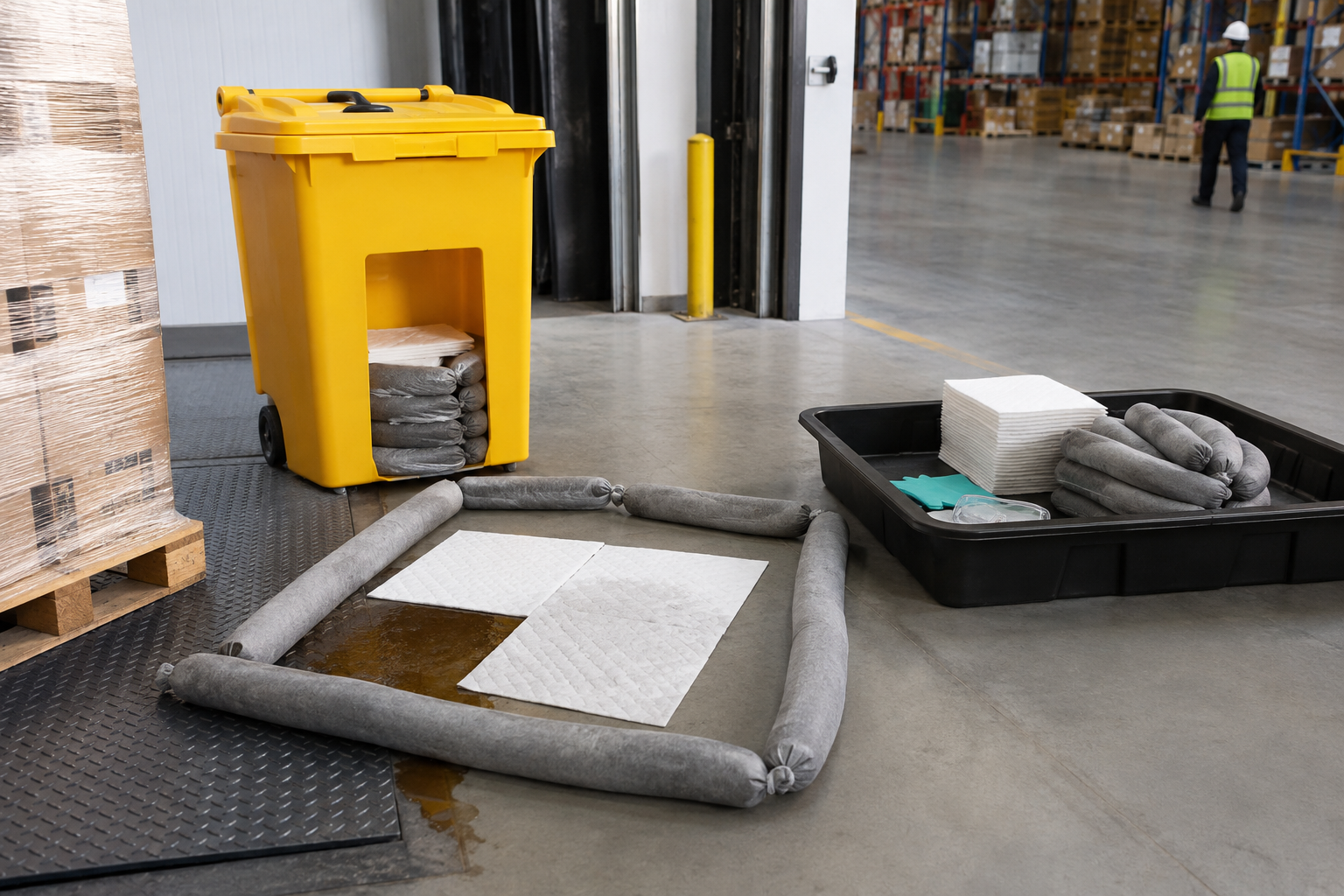
Loading Dock and Warehouse Spill Control: A B2B Buyer’s Guide
Why loading docks and warehouses need a dedicated spill plan
A loading dock is one of the few places on an industrial site where a single piece of equipment — a parked trailer, a forklift, a charged pallet, an IBC — sits directly on a hard floor next to a drain or a doorway. Every shift generates small drips from hydraulics, coolant lines, fuel tanks, and battery vents. Most of those drips are caught and wiped up, but the ones that are not become the spills that EHS managers spend their week investigating.
This guide is written for the people who plan for those drips before they become incidents: EHS managers, warehouse and distribution-center supervisors, facility maintenance leads, and procurement officers who stock the absorbents, drip trays, drain protection and spill kits that the dock and warehouse floor run on. It is built around the product set published on the SYVEA Industrial product catalog — absorbent pads in three liquid classes, absorbent socks, spill kits, drip trays, and spill containment products — and around the way those products are positioned in real receiving, storage and dispatch environments.
The aim is a procurement-ready view of the dock and warehouse floor: which product belongs in which zone, how much of it to keep on hand, and how to talk to a supplier when the site layout, the liquids on site, or the volume of traffic changes.
The product families that cover a dock and warehouse floor
SYVEA Industrial groups dock and warehouse spill control into seven product families. Each family solves a specific problem; the seven together cover the surface, the perimeter, and the drain of a typical industrial facility.
Oil absorbent pads
Oil absorbent pads are the standard absorbent around truck bays, dock levelers, and any area where hydrocarbon drips are routine. They are white, repel water, and absorb fuel, hydraulic fluid, lubricating oil, and cutting oil. Stock them at every truck bay and at the foot of every dock leveler.
Universal absorbent pads
Universal absorbent pads absorb oil, water, coolant, and most water based fluids, which is what comes out of forklifts, batteries, HVAC condensate lines, and general receiving areas. They are grey and are the right choice for mixed-traffic aisles where the liquid class varies from shift to shift.
Chemical absorbent pads
Chemical absorbent pads are formulated for acids, bases, solvents, and unknown liquids. They are yellow and belong in hazmat cages, chemical storage rooms, and battery charging areas, never as a substitute for oil or universal pads in the open floor.
Absorbent socks
Absorbent socks are flexible tubes that dike and absorb at the same time. They are laid around the base of drums, across the low point of a service bay, and along the bottom of a doorway to keep a spill inside one zone while the rest of the response is set up. Socks are the bridge between an absorbent pad that wipes up a drip and a containment product that holds back a leak.
Spill kits
Spill kits are the staged emergency response for a dock or warehouse floor. A pre-assembled kit puts pads, socks, and disposal bags in one container, so the first person on the scene is not assembling products during the response. Kits should be mounted at known points along the dock and at the entrance of every storage zone.
Drip trays
Drip trays are the passive capture point under any equipment that drips while it sits. Forklifts parked at chargers, IBCs on standby, hydraulic units, and stationary compressors all drip onto whatever is below them. A drip tray turns that drip into a controlled, replaceable container rather than a floor stain.
Spill containment products
Spill containment products — containment pallets, berms, drain covers, and load-bearing pads — are the larger-scale products that keep a spill inside a defined area. They are sized to the volume of the largest container in the zone and to the flow path between the container and the nearest drain.
Zone-by-zone placement guide
The fastest way to build a spill plan for a dock or warehouse is to walk the floor one zone at a time and assign a product family to each. The table below maps the standard SYVEA Industrial families to the zones they cover.
| Zone | Primary product | Supporting product | Why this combination |
|---|---|---|---|
| Truck bay / dock leveler | Oil absorbent pads | Absorbent socks | Hydrocarbon drips at the parked trailer; socks at the door to keep a leak out of the aisle |
| Drum and IBC row | Absorbent socks | Drip trays, spill containment products | Perimeter containment around each container; passive capture under each valve |
| Forklift charging room | Universal absorbent pads | Chemical absorbent pads, drip trays | Coolant and battery acid exposure; passive capture under parked forklifts |
| Receiving / dispatch aisle | Universal absorbent pads | Absorbent socks | Mixed-traffic aisle; socks across aisle ends for any spreading spill |
| Hazmat / chemical cage | Chemical absorbent pads | Absorbent socks | Aggressive liquids; socks at the cage door to contain a leak before it leaves the cage |
| Drain and wash-down point | Spill containment products | Universal absorbent pads | Drain covers stop a spill at the perimeter; pads catch overspray and puddles |
| Battery charging area | Chemical absorbent pads | Drip trays | Neutralizes electrolyte exposure; tray under each charger |
Truck bays and loading dock levelers
Parked trailers and idling forklifts leave hydrocarbon drips on the floor in the same places every day. Stock oil absorbent pads at every bay, either on a wall-mounted dispenser or in a spill kit. Place a single absorbent sock across the dock leveler lip on days when trailers are turned over quickly, so a drip does not track into the receiving aisle.
Drum and IBC storage areas
A 200-litre drum or a 1000-litre IBC that fails completely puts its full volume onto the floor inside seconds. The first line of defence is a containment pallet from spill containment products, sized to the container. The second is a perimeter of absorbent socks around the base of each drum so a leaking valve does not spread outside the bunded area before the kit arrives. A drip tray under each tap or pump captures the routine drips that show up between inspections.
Forklift charging and battery rooms
Forklifts and batteries bring a mix of liquids: hydraulic oil from the mast, coolant from the radiator, electrolyte from the batteries, and water from the wash-down. Universal absorbent pads cover most of those fluids; chemical absorbent pads handle any acid splash near the chargers. Park each forklift on a drip tray sized to the footprint of the machine.
Receiving and dispatch aisles
Aisles see forklift traffic in both directions and the occasional dropped pallet. Universal absorbent pads are the right absorbent because the liquid class is unpredictable. Absorbent socks at the aisle ends keep any spreading spill out of the next aisle while the response is being set up.
Hazmat and chemical storage cages
Cages that hold acids, bases, or solvents should be lined with chemical absorbent pads on the floor and a perimeter of absorbent socks at the door. A kit with chemical-resistant content should be mounted on the outside of the cage so the first responder does not have to step inside to grab it.
Drainage and wash-down points
The fastest path from a dock to the environment is the storm drain. Spill containment products such as drain covers and berms should be pre-staged at every drain within reach of a dock or storage zone. Universal absorbent pads catch the overspray and any puddle that forms around the drain during wash-down.
Matching liquid class to the zone
Choosing a product is not only about zone. It is also about the liquid that is most likely to be present. SYVEA Industrial publishes its absorbent products in three liquid classes, each colour-coded.
Oil-only (white)
Oil-only products repel water and absorb hydrocarbons. They are white and are the right class for diesel, gasoline, hydraulic fluid, and cutting oil. On a dock, oil-only is the default class around truck bays and outdoor fuel points.
Universal (grey)
Universal products absorb oil, water, coolant, and other water-based fluids. They are grey and are the right class for mixed-traffic aisles, forklift rooms, and receiving areas where the liquid class varies from incident to incident.
Chemical-resistant (yellow)
Chemical-resistant products are formulated for acids, bases, solvents, and unknown liquids. They are yellow and are the right class for hazmat cages, battery rooms, and laboratory storage. They are not a substitute for oil-only or universal pads in the open floor.
Stocking the wrong class for the zone is the most common procurement mistake. Oil-only pads in a coolant aisle will not absorb the spill; universal pads in a chemical cage are not rated for the liquids present.
Sizing the stock: procurement math for the whole site
Sizing the absorbent stock for a dock or warehouse is a site-specific decision. The starting point is always the worst-credible spill at each location, not the typical small drip.
Start from the worst-credible spill
Walk every zone and ask: if the largest container or piece of equipment in that zone failed completely, how much liquid would reach the floor, and what perimeter would the response need to contain it? That worst case is the minimum absorbent stock for that zone; everything else is a refill or a routine top-up.
Count pads by drip points and drum count
Each drum or IBC generates a known drip rate. Each active truck bay generates a known drip rate per shift. Multiply drip rate by the number of pads needed per litre absorbed, and round up to the next pack size. The published product pages for the two pad families list the pack sizes available for restocking.
Count socks by perimeter
For drum rows and IBC storage, count the linear metres around the base of every container that could leak, then add a margin for the doorway and the drain. The socks product page lists section lengths to help convert linear metres into stock quantity.
Count drip trays by active drip sources
Count every piece of equipment that is parked, charged, or stored in one place for more than a shift: forklifts, IBCs on standby, hydraulic units, stationary compressors. Each one needs a drip tray sized to its footprint and the volume of liquid it could release.
Count spill kits by site layout
Mount at least one spill kit at the entrance of every zone, plus one at the dock itself and one at the drain. The exact count depends on the distance from any point in the zone to the nearest kit; a worker should be able to reach a kit in under thirty seconds.
Inspection, storage and rotation
A spill product that has been sitting on a shelf for two years in the sun is not a spill product anymore. Inspection and storage are part of the procurement cycle, not separate from it.
Store all absorbent products flat in their original packaging, in a dry area, away from direct sunlight. UV exposure degrades the outer skin of pads, socks, and booms over time. Drip trays and containment pallets should be stored where the forklift can reach them without moving other stock.
Inspect stock on a monthly cycle. Check pads and socks for torn outer skins, compressed sections, and signs of moisture or contamination. A pad or sock that has absorbed anything is no longer a usable product; bag it as waste and replace it. Rotate stock on a first-in, first-out basis so older stock leaves first.
Replace any product that has been exposed to moisture, contamination, or direct sunlight. Do not return opened packs to the rotation.
Working with a supplier
Procurement officers running a dock or warehouse usually have three questions for a spill-control supplier:
- Which product class matches the liquids in each zone? The supplier should be able to walk the floor or review a layout and recommend a product mix per zone, not just a single SKU.
- What is the recommended stock level for the worst-credible spill? The supplier should size the stock from the container count and the floor area, not from a generic recommendation.
- How is replacement handled? The supplier should describe how pads, socks, and drip tray inserts are restocked, and how used absorbent waste is handled under local rules.
A useful supplier conversation starts with a site layout and a list of liquids present, not with a SKU number. Sending a floor plan and a list of the largest containers on site to SYVEA Industrial gives the supplier enough to recommend a product mix and a stock level on the first reply.
FAQ
Which absorbent pad class belongs in a forklift charging room?
Universal absorbent pads are the right default for forklift traffic because they absorb oil, water, coolant, and most water-based fluids. Chemical-resistant pads should be added at the battery chargers specifically, because electrolyte exposure requires the yellow chemical class.
How many drip trays does a warehouse typically need?
A useful rule is one drip tray per parked piece of equipment that drips while idle: every forklift on charge, every IBC on standby, every stationary hydraulic unit, and every stationary compressor. Multiply the count by the equipment footprint to size the tray.
Where should spill kits be mounted?
Mount a spill kit at the entrance of every storage zone, plus one at the dock and one at the nearest drain. The target is that any worker can reach a kit in under thirty seconds from any point in the zone.
Do I need chemical-resistant pads if I do not store aggressive liquids?
If the zone contains only oil and water-based fluids, chemical-resistant pads are not required. Stock oil-only pads around truck bays and universal pads in mixed-traffic aisles, and reserve chemical-resistant pads for hazmat cages, battery rooms, and laboratory storage.
How long do absorbent pads, socks, and drip trays last in storage?
All three product families have a multi-year shelf life when stored dry and away from direct sunlight. Inspect the stock monthly and rotate on a first-in, first-out basis. Replace any product that has been exposed to moisture, contamination, or UV.
Closing
A loading dock and warehouse floor does not need a generic safety article — it needs a placement plan that puts the right product in the right zone, with a stock level sized to the worst-credible spill at each location. Walking the floor zone by zone, matching the product class to the liquids present, and sizing stock from container count and floor area is enough to put a defensible plan in place. To get a tailored recommendation, send the site layout, the liquid list, and the largest container in each zone to SYVEA Industrial, or revisit the full product catalog to shortlist the product families that fit the floor.
发表回复