Drip Tray Selection and Sizing for Industrial Equipment: A B2B Procurement Guide
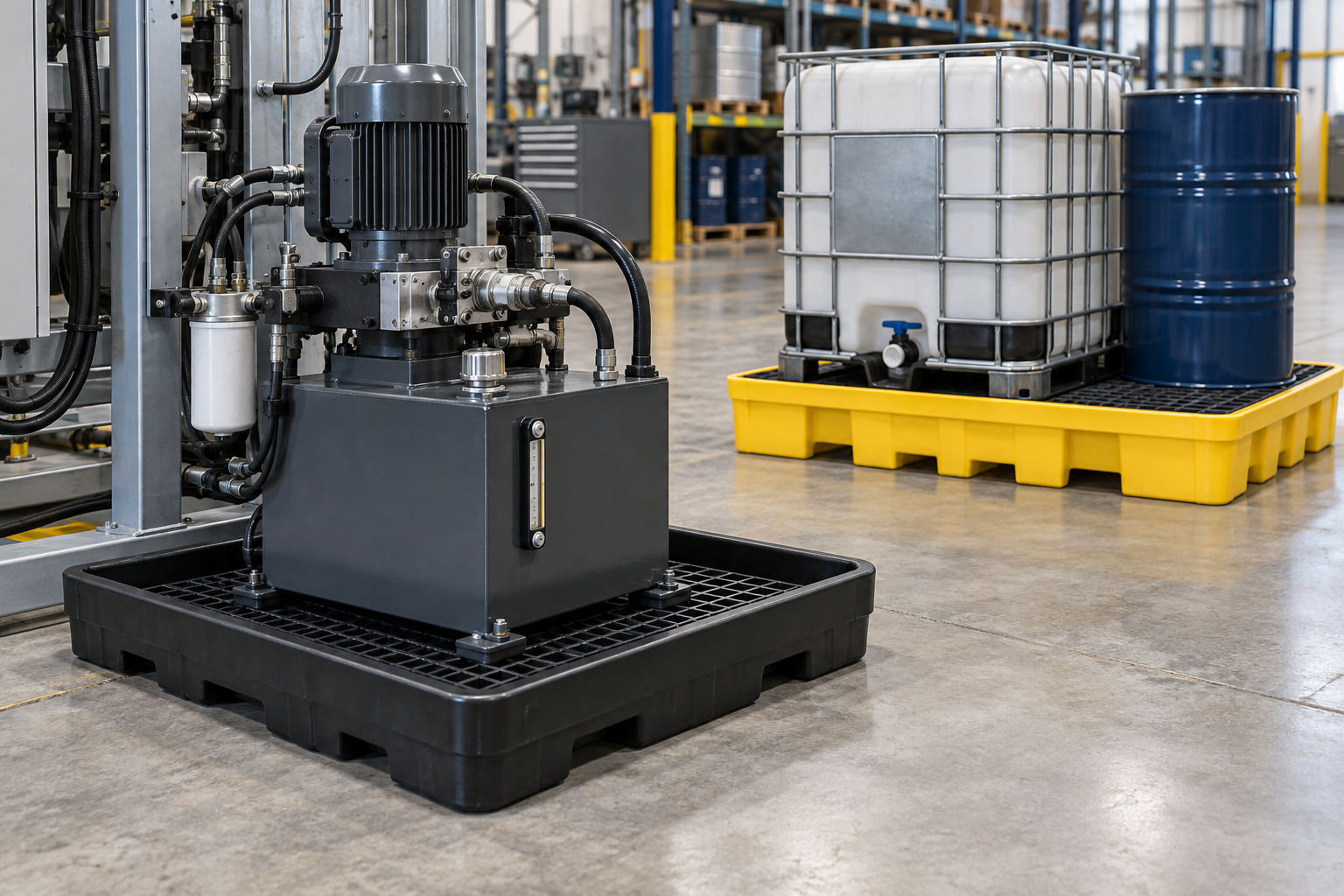
A drip tray is one of the least expensive pieces of spill-control hardware an industrial site will ever buy, and one of the most overlooked. It sits under a parked forklift, a standby IBC, a hydraulic power unit, or a stationary compressor, and turns what would be a permanent floor stain into a removable, replaceable insert. Specified well, a drip tray catches routine drips before they spread, holds them away from the drain, and buys the EHS team time to react. Specified poorly, it is a steel box that blocks the floor jack, fills with rainwater, and overflows the first time a hydraulic line weeps.
This guide is written for the people who buy and place that hardware: industrial procurement officers, EHS managers, facility maintenance leads, warehouse supervisors, and the distributors who supply them. It draws on the product catalog published on the SYVEA Industrial product catalog — in particular drip trays and the spill containment products family that surrounds them — and on the way those products are deployed under real industrial equipment.
What a drip tray actually does on an industrial floor
A drip tray has one job: catch liquid that drips out of equipment while the equipment is parked, charged, or in standby. The liquid class on a working industrial floor is predictable — hydraulic oil from forklift masts, coolant from radiators, electrolyte from batteries, fuel from idling engines, condensate from compressors, and the occasional process liquid from valves and pumps. The drip tray catches those liquids at the source, before they reach a drain or trigger an EHS investigation.
A drip tray is not a spill kit, and it is not a containment pallet. A spill kit is staged emergency response for a release that is already in progress. A containment pallet is sized to the volume of the largest container in a storage zone. A drip tray is sized to the footprint of the equipment that sits on top of it and to the volume of liquid that equipment could plausibly release in a single drip event. Used together, the three products cover three time horizons: the daily drip, the worst-credible release, and the emergency response.
The product families a drip tray sits between
Drip trays do not replace any other product family in the SYVEA Industrial catalog. They sit between the absorbent pads that wipe up small releases and the spill containment products that hold back the worst case. Understanding that layering is the first step in specifying the right drip tray for a zone.
Drip trays
Drip trays are the passive capture point under any piece of equipment that drips while it sits. They are typically shallow, have a removable grid or insert, and are sized to a single piece of equipment. The drip tray is the product family to specify when the equipment is stationary, the drip rate is low, and the response is inspection-and-replace rather than emergency-response.
Spill containment products
Spill containment products — containment pallets, berms, drain covers, and load-bearing pads — are the larger-scale products that hold a release inside a defined area. A drip tray on its own is not a containment solution for a 200-litre drum or a 1000-litre IBC. A containment pallet under the container plus a drip tray under each valve is the correct layering for a drum and IBC row.
Absorbent socks
Absorbent socks are flexible tubes that dike and absorb at the same time. They are useful around the perimeter of a drip tray placement to keep an overspread from reaching the next aisle. A drip tray plus a perimeter of absorbent socks is the standard layout under a forklift charging point or a hydraulic unit in a maintenance bay.
Oil absorbent pads and universal absorbent pads
Oil absorbent pads and universal absorbent pads are not drip tray substitutes; they are the wipe-up medium once the tray has done its job. A pad picks up what remains in the tray insert when the insert is removed for cleaning or disposal.
How to size a drip tray for a specific piece of equipment
Sizing a drip tray correctly is a footprint and volume decision. It is not a generic recommendation. The two numbers that matter are the footprint of the equipment and the volume of the largest credible single release from that equipment.
| Equipment | Minimum tray footprint | Liquid class typically present | Supporting product pairings |
|---|---|---|---|
| Electric forklift on charge | Full footprint of the forklift plus a 100 mm perimeter margin | Coolant, hydraulic oil, battery electrolyte (under the charger) | Universal absorbent pads, chemical absorbent pads at the charger, absorbent socks across the doorway |
| IBC on standby (1000 L) | Footprint of the IBC plus 100 mm perimeter; or a containment pallet sized to the full IBC volume | Process liquid inside the IBC; occasional drips from the valve | Containment pallet under the IBC; drip tray under the valve or pump |
| Hydraulic power pack / HPU | Footprint of the HPU plus 100 mm perimeter | Hydraulic oil | Oil absorbent pads, absorbent socks across the doorway |
| Stationary air compressor | Footprint of the compressor plus 100 mm perimeter | Compressor oil, condensate | Universal absorbent pads, drain for condensate routed to a drip tray |
| Diesel generator on standby | Footprint of the generator plus a sub-base tank drip tray sized to daily fuel seepage | Diesel fuel, engine oil, coolant | Oil absorbent pads, spill kit mounted at the door of the generator room |
| Drum pump or tap on a 200 L drum | Small drip tray sized to the tap footprint only | The product inside the drum | Containment pallet under the drum; oil absorbent pads at the pump |
| Battery charging rack | Footprint of the rack plus 100 mm perimeter; chemical compatibility mandatory | Battery electrolyte | Chemical absorbent pads, drip trays under each charger |
The 100 mm perimeter margin is the conservative default for most procurement situations. A tighter margin is acceptable when the equipment is bolted down and the floor around it is regularly inspected; a wider margin is required when the equipment has flexible hoses or moving parts that could direct a release outside the immediate footprint.
Match the tray material to the liquid class
Material compatibility is the single most common drip tray specification error. A polyethylene tray is the safe default for most water-based fluids, coolants, and battery electrolyte. A steel tray is appropriate for hydrocarbons and for forklift and equipment footprints that exceed the load rating of a typical plastic tray. A chemical-resistant tray is required for any zone where aggressive liquids — acids, bases, solvents — are stored, charged, or pumped.
Specifying a steel drip tray under a battery charger, or a polyethylene tray under a hydrocarbon source, is the procurement mistake that shows up most often at the audit. The first corrodes through, the second cracks on contact with the wrong class. Both are simple to avoid once material compatibility is added to the procurement spec.
Match the tray capacity to the worst credible single release
Capacity is the second number. A forklift that drips a few millilitres of hydraulic oil per shift does not need a 200-litre containment pallet under it; a 10-litre drip tray with a removable insert is the right size. An IBC valve that fails in a single event could release its full contents; a drip tray is not the right product for that scenario, and a containment pallet sized to the IBC must be specified instead.
The right sizing rule is to start from the worst-credible single release for that specific piece of equipment, then round up to the next standard tray size. The published product page for drip trays lists the available footprints and capacities; the procurement decision is which of those standard sizes matches the equipment list.
Placement rules that procurement should specify up front
Where the drip tray sits is as important as what it is made of. Three placement rules cover most situations.
Place the tray on a level, accessible floor
A drip tray that is tilted, wedged under a leg, or buried under a pallet of stock is not a drip tray — it is a future problem. Specify that trays are placed on a level, finished floor; that the floor under the tray is inspected at the same cadence as the tray itself; and that no stock, pallet, or piece of equipment is stacked on top of, in front of, or behind the tray in a way that prevents inspection or replacement of the insert.
Leave a clear perimeter for inspection
A 600 mm clear perimeter around the tray is the conservative default for a forklift or HPU placement. The clear perimeter is the space a worker needs to crouch down, lift the insert, and place a fresh insert or a pad without stepping on another piece of equipment. Specifying the perimeter at the procurement stage is much cheaper than enforcing it after the equipment is in place.
Pair the tray with the right absorbent class for the zone
A drip tray in a forklift charging room pairs with universal absorbent pads because the floor sees oil, water, and coolant. A drip tray in a battery charging area pairs with chemical absorbent pads because the floor sees electrolyte. A drip tray under a hydraulic unit pairs with oil absorbent pads because the floor sees only hydrocarbons. Specifying the wrong pad class next to the tray is as common a procurement error as specifying the wrong tray material.
Inspection, rotation, and replacement cadence
A drip tray that has not been inspected in two years is a container of unknown liquid sitting under equipment. Inspection cadence belongs in the procurement spec, not in a separate procedure.
Inspect each tray monthly. Lift the insert and check for liquid, for corrosion on steel trays, for cracks on polyethylene trays, and for any sign that the insert has been bypassed or wedged back into place. Replace the insert at every known release, and on a quarterly routine cycle. Replace the entire tray when the body shows corrosion, cracking, or deformation; never return a damaged tray to service.
Rotate stock so replacement inserts are on hand before they are needed. A typical rule is one replacement insert per tray in active service, kept at the maintenance crib or on the nearest spill response point. Running out of inserts is the failure that turns a working drip tray program into a sticker program.
Common procurement errors and how to avoid them
Five errors account for most of the drip tray problems seen during site audits. They are easy to avoid with a tighter procurement spec.
Undersizing the tray for the equipment footprint
The most common error. A drip tray that fits the wheelbase of the forklift but does not extend to the mast or the back of the chassis will miss any drip outside the wheelbase. The fix is to size the tray to the full footprint of the equipment plus the perimeter margin, not to the wheelbase.
Specifying the wrong material for the liquid class
Steel under electrolyte corrodes; polyethylene under hydrocarbons can crack under load. The fix is to specify the tray material by the liquid class present at the placement, not by the equipment type alone.
Blocking access to the tray with stock or other equipment
The tray is placed correctly at installation and buried under a pallet six months later. Specify the clear perimeter at procurement and enforce it during floor walks. A tray that cannot be inspected does not exist.
Using a drip tray as a substitute for a containment pallet
A drip tray under a 200-litre drum is the wrong product; a containment pallet is the right product. The fix is to specify the drip tray for the equipment that drips while idle, and the containment pallet for the container that could fail completely.
Running out of replacement inserts
The drip tray is in place; the insert has been used and not replaced. Keep one replacement insert per tray on hand at the maintenance crib, and add insert replacement to the same monthly inspection cadence that checks the tray itself.
Working with a supplier on a drip tray program
A useful supplier conversation on drip trays starts with the equipment list, not a SKU. Send the count and the footprint of every piece of equipment that drips while idle on the site — forklifts on charge, IBCs on standby, hydraulic power units, stationary compressors, drum pumps, battery charging racks, diesel generators — and ask for a tray recommendation per piece of equipment, including the material, capacity, and replacement insert cadence.
Ask for the tray specification in writing, including the load rating for any plastic tray under a heavy forklift or IBC. Ask how the supplier handles replacement inserts and how used inserts are disposed of under local rules. The published drip trays product page lists the available footprints and materials; the supplier’s job is to map that catalog onto the specific equipment list of the site.
Send the equipment list, the liquid class at each placement, and the existing absorbent stock to SYVEA Industrial for a tray-by-tray recommendation and stock plan on the first reply.
FAQ
How many drip trays does a typical industrial facility need?
One drip tray per parked piece of equipment that drips while idle: every forklift on charge, every IBC on standby, every hydraulic power unit, every stationary compressor, every drum pump, every battery charging rack. A 50-person warehouse with 12 forklifts, 6 IBCs on standby, 4 hydraulic units, and 2 stationary compressors starts at 24 trays before any spare stock.
What size drip tray fits a standard electric forklift?
The tray should cover the full footprint of the forklift with at least a 100 mm perimeter margin on every side. The exact dimensions depend on the forklift model; write the spec against the specific forklift list at the site.
Can a drip tray sit under a 1000-litre IBC?
Only as a secondary measure. A drip tray under the IBC valve or pump handles routine drips; a containment pallet sized to the full IBC volume handles a worst-case release. The correct layering is containment pallet under the IBC plus a drip tray under each valve or pump.
How often should a drip tray be inspected?
Monthly visual inspection of the tray body and the floor underneath, with the insert lifted and replaced at every known release and on a quarterly routine cycle. The cadence should be written into the procurement spec, not left to the floor team.
What is the difference between a drip tray and a containment pallet?
A drip tray is sized to the equipment that sits on top of it and to routine drips. A containment pallet is sized to the full volume of the container that sits on top of it and to the worst-credible single release. Drip trays handle the daily drip; containment pallets handle the worst case; spill kits handle the emergency response.
Closing
A drip tray program does not need a generic safety article; it needs an equipment list, a footprint-to-tray match-up, a material specified by liquid class, and a replacement insert kept on hand. Walking the floor piece by piece, matching the tray footprint to the equipment footprint, matching the tray material to the liquid class present, and adding the replacement insert to the monthly inspection cadence is enough to put a defensible program in place. To get a tray-by-tray recommendation, send the equipment list and existing absorbent stock to SYVEA Industrial, or revisit the product catalog to shortlist the tray sizes that fit the floor.
发表回复