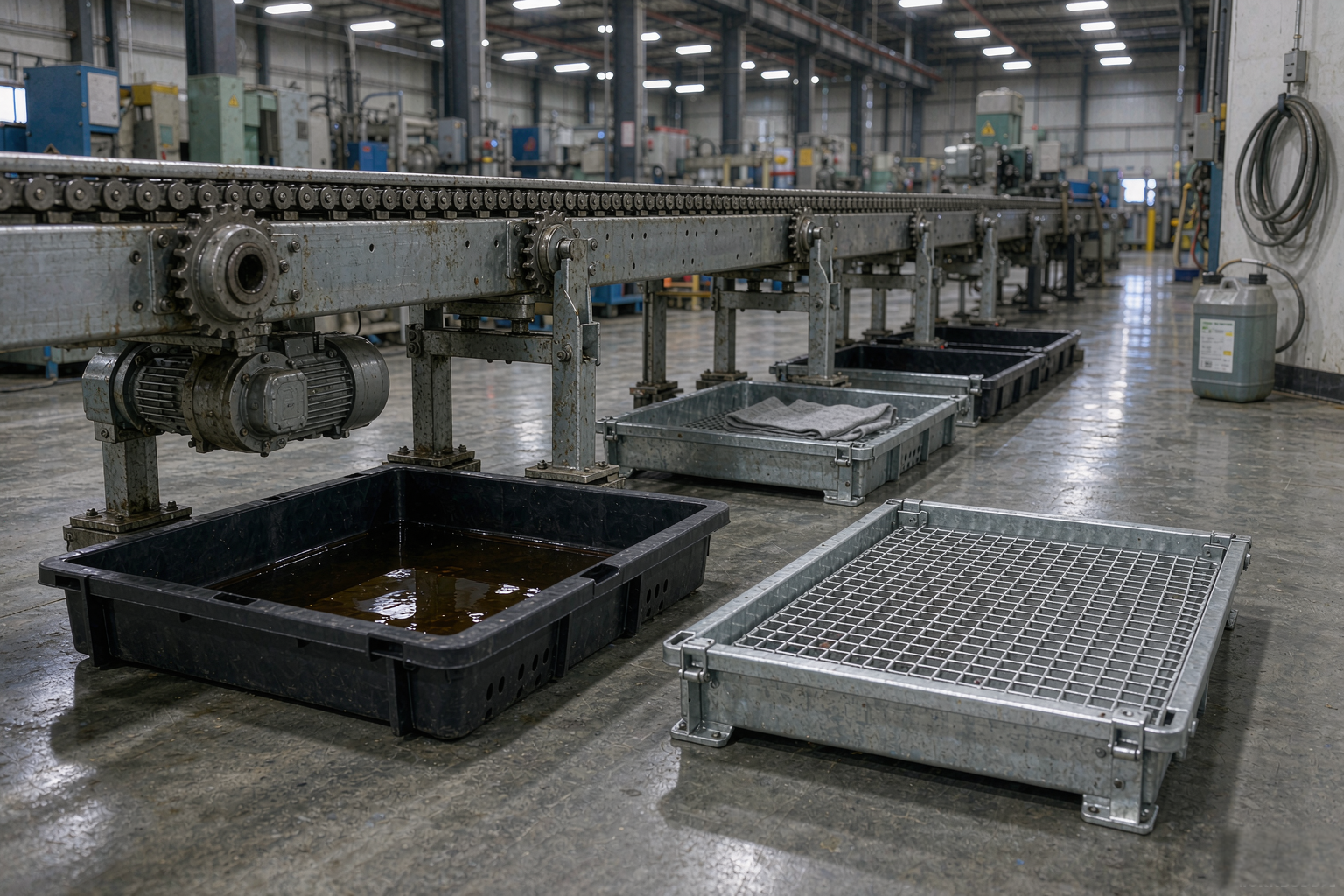
Where a conveyor line actually sheds liquid
A conveyor runs for hours at a time, and the liquid it releases arrives the same way every shift: a few drops at a time, at the same points. Drive units and gearboxes seep lubricant. Chain and roller returns carry oil along the underside of the run. Transfer points shed whatever the product was carrying. Washdown water collects at the low end of an incline. None of it arrives fast enough to look like a spill, which is exactly why it reaches the walkway, the pit, or the drain before anyone notices.
That pattern creates a specific problem for maintenance planning. A single release is easy to handle. A release that repeats all shift, at the same spot, every day, becomes a standing task that competes with everything else on the list, and the workaround is usually a rag, a tray borrowed from somewhere else, or nothing at all.
A conveyor drip tray changes the order of those events. Rather than letting the liquid reach the floor and cleaning it up afterwards, the tray sits where the liquid lands and holds it there until it is drained.
What a conveyor drip tray is
SYVEA Industrial Drip Trays are heavy-duty spill containment trays manufactured from high-density polyethylene (HDPE) and polyethylene (PE). They are designed for long-term deployment under machinery, storage drums, IBC totes, batteries, and dispensing stations to catch leaks, drips, and spills at the source. Under a conveyor line, the under-machinery part of that description is the whole point.
Containment, not wipe-up
A drip tray is a vessel, not a wipe-up medium, and the distinction matters as soon as you write the specification. A product designed to take liquid up is sized by how much it will hold. A tray is sized by how much its sump will hold before it has to be emptied, and by whether whatever stands or drips above it fits inside the deck. Those are two different questions, and specifying against the wrong one is a common way for a containment project to stall.
Drip trays feature a robust ribbed or flat deck construction with a containment sump that captures leaking liquids. The deck is the surface the line drains onto; the sump is what holds the liquid until someone drains it.
Materials and finish
Trays come in multiple sizes and load capacities, with optional drain plugs and removable grates. Every tray is chemical-resistant, UV-stabilized, and stackable, which keeps storage and transport of spare units simple. The full range is on the drip trays product page.
Sizing a tray to the drips you actually get
Three specifications decide the tray: how much liquid the sump holds, how much the deck will carry, and how much of the line the tray covers.
| Specification | Approved value | What it decides |
|---|---|---|
| Sump capacity options | 20L, 40L, 80L, 120L, 240L | how often the tray has to be drained |
| Load capacity | Up to 1,000 kg static load | whether drums, totes, or machine feet can stand inside the tray |
| Dimensions | Various – 60x40cm to 180x130cm (customizable) | how much of the conveyor section is covered |
| Material | HDPE / PE (Polyethylene) | chemical exposure and outdoor UV exposure |
| Chemical resistance | Resistant to oils, acids, bases, and most industrial chemicals | which liquid classes the tray suits |
Read the drip before you read the floor area
Work from the drip, not from the floor area. A drive unit that seeps a few drops a shift and a transfer point that sheds process liquid all day are different jobs even when they stand on the same conveyor. Sump capacity options run from 20L to 240L, so the practical question is how long you want the tray to run between drains. A tray that has to be drained mid-shift costs more labour than a larger tray that runs a full week, and that difference is usually settled at the first maintenance review rather than on the order.
Footprint and customization
Footprint is the second half of the decision. Drip tray dimensions run from 60x40cm to 180x130cm, and sizes are customizable, so the tray can be matched to the section of line it has to cover rather than to whatever size happens to be in stock. On a long conveyor that usually means several trays rather than one oversized unit, which is also easier to handle at drain time.
Load, material, and chemical compatibility
Static load is the rating that matters
Load capacity is quoted as up to 1,000 kg static load. Static is the operative word: it describes a stationary load carried by the tray, not a load dropped, rolled, or driven onto it. If a drum or an IBC tote is going to stand inside the tray, that figure is the one to check against the weight of the full container. If the tray is only catching drips from a line that stands on its own legs, the load figure matters less than the sump and the footprint.
Which liquids the tray suits
The tray material is HDPE / PE (Polyethylene). That choice is what sits behind the chemical resistance rating, which covers oils, acids, bases, and most industrial chemicals. Trays are also UV-stabilized, so a unit placed near a loading door or in a yard does not depend on being permanently out of the sun. If the liquid at a point falls outside that list, flag it at inquiry stage and have the chemistry checked against the tray before the order is placed.
Placement, drainage, and the maintenance routine
Where the trays go
Drip trays are deployed under machinery, and on a conveyor line the machinery that matters is the drive unit, the gearbox and lubrication points, the underside of the return run, and the discharge end. Those are the points a conveyor line sheds liquid from, and they are rarely the points where a floor drain was put.
Where one tray will not span the area, the interlocking design lets trays be joined into a longer run, so a single drip line can be covered by a set rather than by an oversized fabrication.
Cleaning and drainage
A removable grate gives access to the sump for cleaning, and an optional drain plug allows a full tray to be emptied without lifting it. Those two details decide how the routine actually works. With a drain plug the job is a hose or a drum and a few minutes. Without one it is a lift, and a lift is the step that gets deferred.
If the worst-credible release at a point is a whole drum or tote rather than a drip, spill containment products such as pallets and berms cover that case.
Drain on the schedule the drip rate sets, not the calendar. If the sump is a third full at the end of a week, that is the interval to plan around. If it is full at the end of a shift, the tray is undersized for that point and the fix is a larger sump or a second tray, not a more frequent drain.
FAQ
Q: What is a conveyor drip tray?
A: A conveyor drip tray is a heavy-duty spill containment tray deployed under machinery to catch leaks, drips, and spills at the source. On a conveyor line it is positioned where the line sheds liquid, such as a drive unit or a transfer point.
Q: What sump capacity options are available?
A: Sump capacity options are 20L, 40L, 80L, 120L, 240L. Which one suits a given point depends on how much liquid the line sheds between drains.
Q: What sizes do conveyor drip trays come in?
A: Drip tray dimensions are various – 60x40cm to 180x130cm, and sizes are customizable. Match the footprint to the section of line the tray has to cover.
Q: How much weight can a drip tray carry?
A: Load capacity is up to 1,000 kg static load. That rating applies to a stationary load, such as a drum or a tote standing inside the tray.
Q: What are drip trays made of, and what will they resist?
A: The tray material is HDPE / PE (Polyethylene). Trays are chemical-resistant and resistant to oils, acids, bases, and most industrial chemicals.
Specifying conveyor drip trays for your line
Tell SYVEA Industrial which section of the line you are working on and what it sheds. We will help you match a tray on footprint, sump size, and load rating, and tell you whether the case calls for a drip tray or a different containment product.
View drip trays
Browse the full product range
Contact our team
发表回复