How Many Oil Absorbent Pads Do I Need?
Introduction
Estimating how many oil absorbent pads your facility needs starts with three numbers: the area to protect, the absorption capacity of the pad, and how often oil spills occur. Ordering too few pads leaves workstations and machinery exposed between restocks. Ordering far more than needed ties up working capital in slow-moving inventory.
This guide walks industrial procurement teams, maintenance managers, and EHS leads through a step-by-step method to estimate pad quantities, using the verified specifications of SYVEA Industrial oil absorbent pads.
What One Oil Absorbent Pad Covers
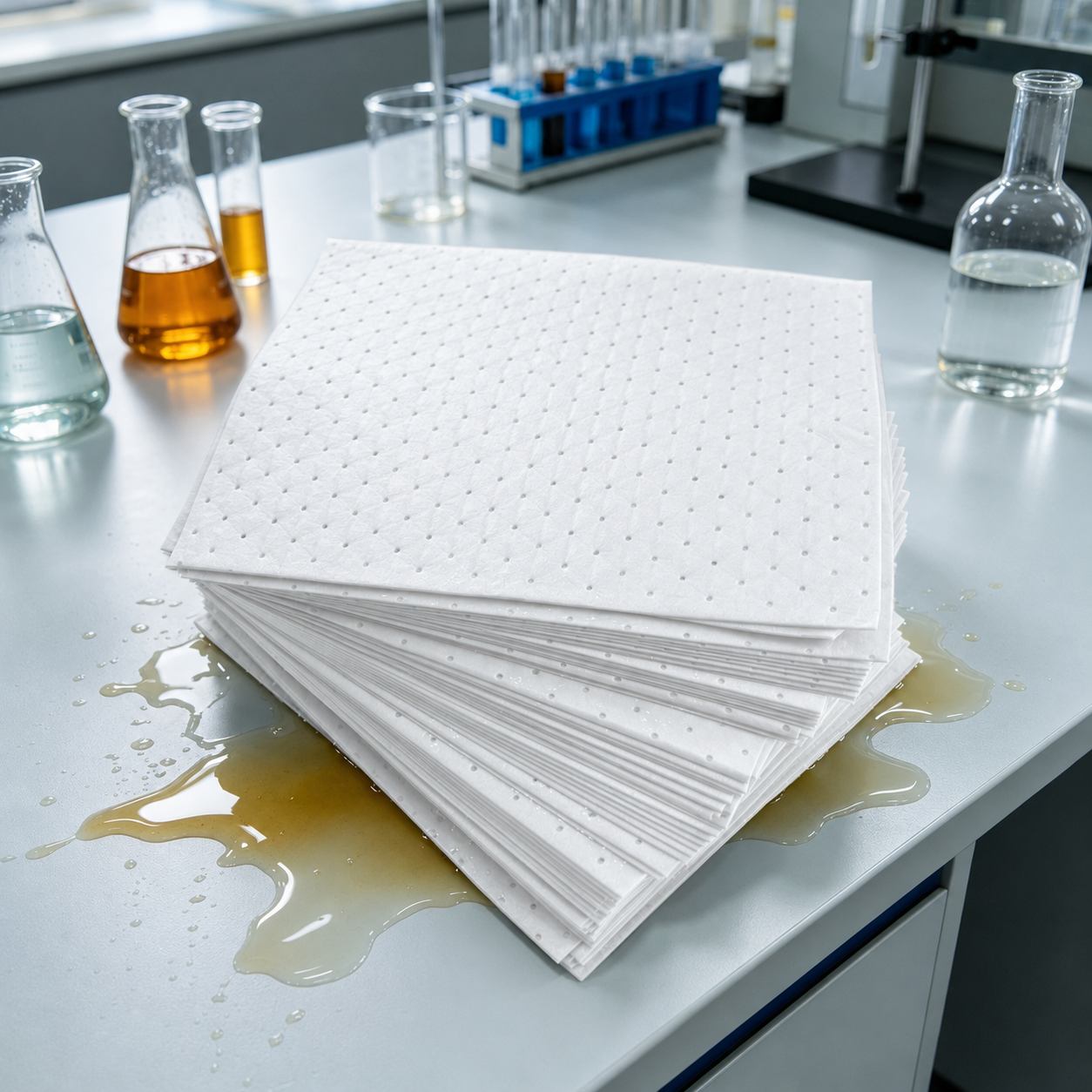
SYVEA Industrial oil absorbent pads measure 40 cm x 50 cm as standard, and custom sizing is available. In square-meter terms, each standard pad covers 0.2 square meters. Five pads laid edge to edge cover roughly one square meter of floor.
The pad body is white meltblown polypropylene. Oil absorbent pads absorb oil and hydrocarbons while repelling water. Basis weight options are 200, 300, 400, or 500 gsm, and each pad absorbs up to 25 times its own weight.
Step 1: List Your Spill Points
Start by listing every location where oil is handled, stored, or drips onto the floor:
- Machine tool areas and drip zones
- Drum and tote storage areas
- Forklift and vehicle maintenance bays
- Loading docks and transfer points
- Workbenches, parts-washing stations, and filter stations
For each location, record the approximate floor area where pads will be placed under equipment or along drip paths.
Step 2: Calculate Coverage per Location
Divide the protected floor area by the coverage of one pad. Because each standard pad covers 0.2 square meters:
- 1 square meter of protected area ??about 5 pads per layer
- 2 square meters of protected area ??about 10 pads per layer
- 5 square meters of protected area ??about 25 pads per layer
Most facilities keep one layer in place under equipment and one spare layer in stock for replacement. Double the per-layer quantity for locations where pads are changed daily.
Step 3: Estimate Absorbed Volume per Pad
Absorption capacity scales with pad weight. A 400 gsm pad at the standard 40 cm x 50 cm size weighs about 80 grams, so at up to 25 times its own weight it absorbs roughly 2 liters of oil. A 500 gsm pad absorbs roughly 2.5 liters; a 200 gsm pad roughly 1 liter.
These figures are calculated from the approved pad dimensions, basis weight, and absorption ratio. Actual capacity varies with oil viscosity and temperature, so treat the result as a planning estimate.
Step 4: Add a Working Buffer
Multiply the daily replacement volume by the number of days between orders, then add a buffer of at least 20 percent. A buffer protects against a large single spill, a delivery delay, or a sudden increase in maintenance activity.
Example: a maintenance bay replaces 25 pads per week and orders every four weeks. Base stock is 100 pads. Adding a 20 percent buffer brings the order quantity to 120 pads per cycle.
Worked Example: Two-Bay Workshop
A workshop with two vehicle maintenance bays protects a 4 square meter floor area under both lifts. Per layer, that is about 20 pads. With one working layer and one spare layer, base stock is 40 pads. If the workshop changes the working layer weekly and orders every four weeks, the order quantity is about 40 pads per cycle plus a 20 percent buffer, or roughly 50 pads.
Order in Bags and Cases
Standard packaging for SYVEA Industrial oil absorbent pads is 100 pieces per bag and 200 pieces per case, and custom packaging is available. Compare the calculated quantity against case size so a 200-piece case covers at least one full order cycle where possible.
Pads Are One Part of the Spill Response System
Oil absorbent pads handle drips and small spills on horizontal surfaces. For oil running along a floor edge or around a machine base, absorbent socks contain the flow first, and pads then pick up the pooled oil. For larger spills or spills on water, absorbent booms provide the first containment barrier. Facilities that respond to larger incidents also keep spill kits at fixed locations.
Build the pad calculation first, then evaluate these products for the same spill points.
Frequently Asked Questions (FAQ)
Q: What is the standard size of an oil absorbent pad?
A: The standard size is 40 cm x 50 cm, and custom sizing is available. Each standard pad covers 0.2 square meters.
Q: What basis weights are available?
A: Oil absorbent pads are available at 200, 300, 400, or 500 gsm. Heavier basis weights absorb more liquid per pad and are used where spills are larger or pads are changed less often.
Q: How much can one oil absorbent pad absorb?
A: Each pad absorbs up to 25 times its own weight. A 400 gsm pad at the standard size absorbs roughly 2 liters of oil as a planning estimate.
Q: Do oil absorbent pads absorb water?
A: No. Oil absorbent pads absorb oil and hydrocarbons while repelling water, which makes them suitable where oil must be collected without taking up surrounding water.
Q: How are oil absorbent pads packaged for bulk orders?
A: Standard packaging is 100 pieces per bag and 200 pieces per case, and custom packaging is available.
Request a Quantity Recommendation
SYVEA Industrial supplies oil absorbent pads with clear, verifiable specifications. Send your spill-point list and floor areas to the SYVEA Industrial team for a quantity recommendation, custom sizing, and packaging options.
View Oil Absorbent Pads -Oil-selective pads for petroleum and hydrocarbon spills.
View Absorbent Socks -Contain oil flowing around machine bases and floor edges.
View Absorbent Booms -First containment barrier for larger spills.
View Spill Kits ??Pre-assembled response sets for fixed locations.
Browse All Products -Complete range of spill-control and absorbent solutions.
Contact Our Team -Discuss your facility’s spill-response requirements with a specialist.
发表回复