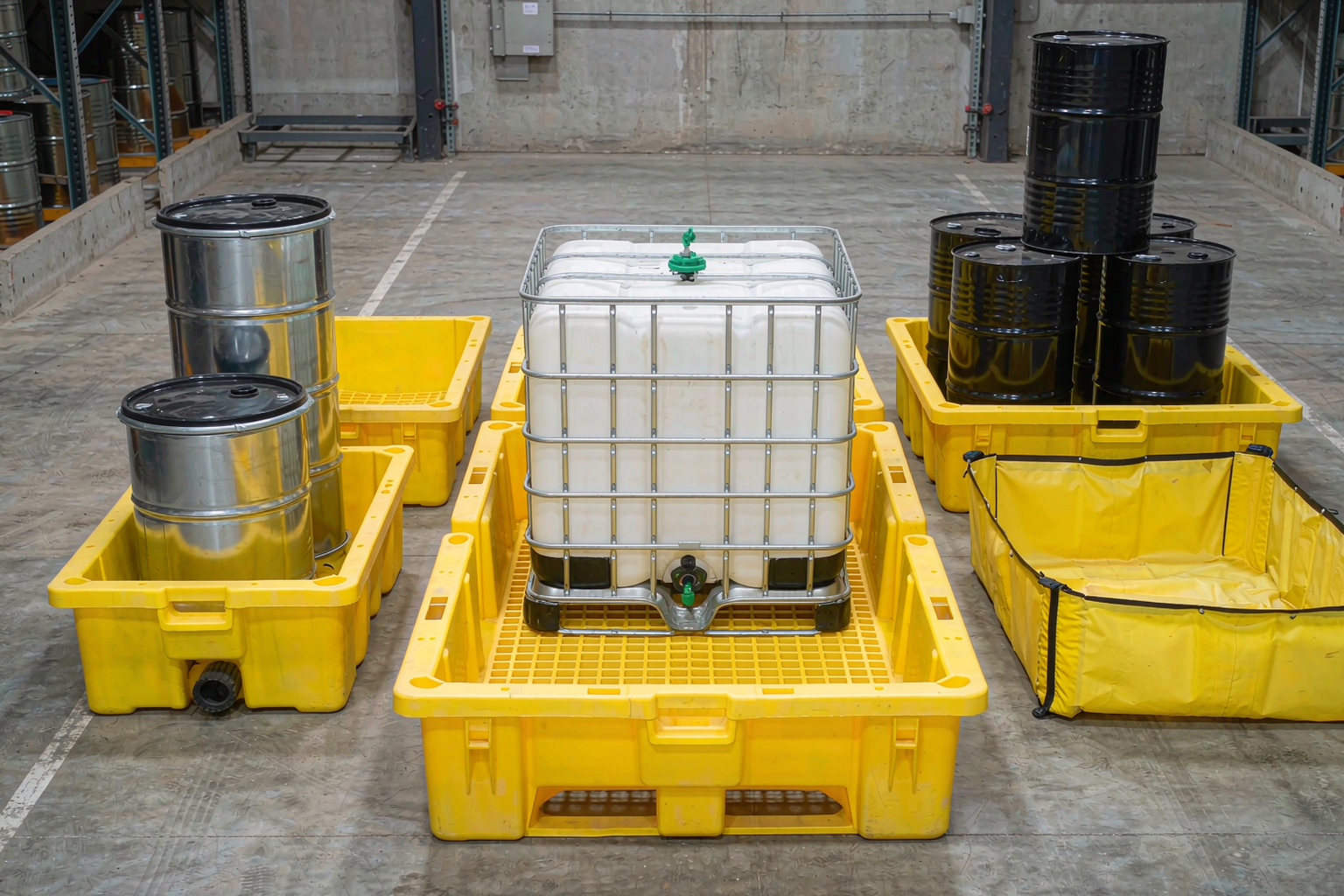
Secondary containment for IBCs, drums and totes is usually bought after a near miss rather than before one. A drum weeps onto a warehouse floor, somebody reaches for a mop, and the next purchase order carries a line item that nobody has had time to specify properly. That is where most of the value is lost. The unit that arrives is either too shallow to hold a slow leak, too small to sit under the container it is meant to catch, or too tall for a pallet jack to enter — and it ends up parked in a corner while the floor keeps getting wet.
This guide is written for the people who specify and buy that hardware: industrial procurement officers, EHS managers, facility maintenance leads, warehouse supervisors, and the distributors who supply them. It works through four decisions in order, because each one constrains the next. First, what volume the unit has to hold. Second, which containment format is built to hold it. Third, how to size that format to a specific container. Fourth, where the unit can physically live on the floor. The product families referenced throughout are published on the spill containment products page of the SYVEA Industrial catalog.
Why this is a sizing decision before it is a purchase
A containment unit is not a container in the ordinary sense. It is a passive reserve volume that sits under a container and waits. That reserve is sized to one number: the largest credible release from the largest container standing in it. Everything else about the purchase — the format, the wall thickness, the load rating, the handling method — follows from that single figure.
Buyers who skip the sizing step tend to buy on impression instead. A shallow tray looks adequate next to a 20-litre pail. The same tray looks obviously inadequate next to a 1000-litre intermediate bulk container, yet it is often the same SKU that gets ordered for both, because nobody converted the container volume into a reserve volume on paper. The conversion takes one line of arithmetic, and it determines whether the purchase does its job on the day it is needed.
What the containment unit actually has to hold
Three volumes go into the sizing calculation, and only the first one is obvious.
The largest container rule
The reserve volume is set by the largest single container that will stand in or on the unit, not by the total volume stored in the area. Two 200-litre drums in one sump do not require a 400-litre reserve if each drum is separately contained or if the drums are treated as independent hazards. They do require it if a single event can breach both at once — which is exactly what occurs when drums are stacked, when they share a manifold, or when they sit close enough that one failure can reach the other. The rule is written as “largest container”, but it is really “largest quantity that can leave containment in one event”.
The freeboard allowance
A containment unit filled exactly to its rim has no reserve left. Working capacity is therefore always lower than nominal capacity, and the difference is the freeboard that keeps a surge from slopping over the edge during the release itself. Buyers should ask for the working capacity, not the nominal figure, and should treat any unit quoted only at nominal capacity as unresolved until the working figure is confirmed.
Volume that arrives from outside the container
Outdoor and semi-outdoor installations collect rainwater. Wash-down bays collect hose water. Both add volume the containment unit did not plan for, and both are routinely overlooked in sizing. An uncovered unit under a roofline still takes splash. A unit in a wash-down area can take more water in a month than the container above it will ever release. This is a placement problem as much as a sizing problem, and it is the most common reason a correctly sized unit overflows anyway.
The containment formats and where each one belongs
Once the reserve volume is known, the format is a question of how the container is handled and where it sits.
Containment sumps and basins
A containment sump or basin is a low, open reservoir with a load-bearing floor or removable grating above it. It suits containers that are placed once and left — a standby IBC, a bulk tank connection point, a filling station. Because the container sits inside the footprint rather than on top of a platform, sumps and basins generally achieve the largest reserve volume for a given floor area.
Containment pallets for drums and IBCs
A containment pallet raises the container off the floor on a deck and holds the reserve underneath. The advantage is handling: a pallet can be moved with the container on it, which matters in operations that rotate stock or reconfigure a bay. The trade-off is that deck height adds to the height of the container, which can matter under a mezzanine, a rack beam, or a low door.
Berms and flexible containment
A berm is a walled liner that folds flat and deploys around a footprint. It is the format of choice when the container is large, awkward, or already in place, and when the containment area needs to be taken up temporarily. Berms suit engine-driven equipment, transformers, and temporary storage, where a rigid unit would be impractical to install around an existing asset.
Why a drip tray is a different product
A drip tray sits under equipment that drips while it is parked, charged, or in standby — a forklift, a hydraulic power unit, a compressor. It captures routine drips at the source and is inspected and emptied on a maintenance cadence. It is not sized to hold the contents of the container above it, and it is not a substitute for a containment sump under an IBC or a drum. The two products sit at different points on the same floor and answer different questions.
Decking, shelving and workstations
Where containers are handled at height — chemical carousels, vertical shelving, dispensing benches — containment is integrated into the structure rather than placed on the floor beneath it. These installations are the most layout-sensitive of all, because the reserve volume competes with the working height, and because the handling equipment has to reach the container without fouling the containment wall.
Sizing the containment format to the container
The table below is a starting point for the arithmetic. It states the sizing question for each container type without asserting product specifications.
| Container in use | Handling | Sizing question to answer before ordering |
|---|---|---|
| Single drum, 200 litre class | Pallet jack, drum trolley | Reserve at least the full drum volume, plus freeboard |
| Drum stack or four-drum pallet | Forklift | Reserve for the largest single drum unless one event can breach more than one |
| Single IBC, 1000 litre class | Forklift only | Reserve at least the full IBC volume; confirm the unit is rated for a forklift-loaded IBC |
| IBC row, manifolded | Forklift | Reserve sized to the manifold group, not to one container |
| Tote or container in wash-down bay | Forklift | Reserve plus the wash-down and rain volume actually reaching the unit |
A single 1000-litre IBC
An IBC is the case where sizing shortcuts fail most visibly. The container is large, it is handled by forklift only, and it is usually filled in place — which means a failed valve can empty a substantial part of it into the containment unit without anyone touching the container. The unit must therefore be rated for a forklift-loaded IBC, must accept the full IBC footprint with room for the forks to withdraw, and must offer a reserve equal to the container volume once the IBC is standing in it.
Drum stacks and four-drum pallets
Drums introduce a question that single containers do not: whether the reserve is sized to one drum or to several. The answer depends on whether the drums can fail together. Stacked drums can. Manifolded drums can. Drums that are simply standing side by side in the same sump usually cannot, and sizing to one drum is defensible — provided the buyer has confirmed that no single event can topple or breach a neighbour.
Tote and IBC rows
Where several containers share a filling line or a manifold, the containment unit is protecting a group rather than a container. The sizing figure becomes the volume that can leave the group in one event, which is usually the contents of one container plus whatever the line holds. This is the configuration where a buyer is most likely to under-order, because the floor area looks like it needs several small units when it actually needs one correctly sized large one.
Matching construction to the liquid class
Material choice follows the liquid, the load, and the handling method — in that order.
Polyethylene, steel and lined units
Polyethylene is the common default for drums and IBCs because it resists a wide range of industrial liquids and does not corrode. Steel is chosen where structural load or heat resistance dominates and where the liquid is known to be compatible. Lined units exist for liquids that attack the base material, and they only work if the liner is compatible and stays intact through handling. None of these three is universally correct; each is a match to a specific liquid and load.
Compatibility is set by the liquid, not by the pallet
Buyers sometimes specify containment by copying a neighbouring bay’s order. That works only if the liquid is also the same. A unit that has held a coolant for years may be a poor match for a solvent, and a unit that handles a mild chemical may not handle a caustic. The liquid class has to be named on the specification, not assumed from the container type, and the material has to be confirmed against it before the order is placed.
Load rating and handling method
A containment unit that will receive a forklift-loaded IBC is a different structure from one that will receive a hand-placed pail. The load rating, the deck construction, and the entry geometry all change with the handling method. Buyers should state the handling method on the enquiry — forklift, pallet jack, or hand placement — because it changes the unit that should be quoted, and it changes what the unit can safely accept after installation.
Placement, drainage and inspection
A correctly sized, correctly matched unit can still fail on the floor. Placement decides whether it works.
Working distance from drains and doorways
Containment works by keeping a release inside a defined area until someone deals with it. That requires the area to be positioned so that a release cannot reach a drain, a doorway, or the next aisle before it is noticed. The working distance is set by the site, not by the unit, and it is the first thing to check before the footprint is fixed.
Access for the forklift and the pallet jack
A containment unit that the handling equipment cannot reach is a unit that will be bypassed. The entry geometry has to accept the forks or the wheels that will actually be used, with enough clearance to withdraw them once the container is in place. This is the second most common reason a correctly sized unit goes unused.
Inspection and rotation
Containment is passive until it is full, which means it is easy to forget. A simple inspection cadence — checking the reserve volume, the deck condition, and the accumulated water — is what keeps a correctly specified unit working. Units that are never inspected tend to be discovered full, which is the same outcome as never having installed them.
Frequently asked questions
What is the difference between primary and secondary containment?
Primary containment is the container itself: the drum, the IBC, the tank. Secondary containment is the unit that catches the contents if the primary container fails. The two are specified separately, and a secondary unit is sized to the primary container it protects.
How much reserve volume does an IBC need?
The reserve is sized to the largest quantity that can leave containment in one event, with freeboard above it. For a single IBC handled in place, that figure begins at the full container volume and is confirmed against the unit’s working capacity, not its nominal capacity.
Can a drip tray be used as secondary containment?
No. A drip tray is sized for routine drips from parked equipment and is emptied on a maintenance cadence. It does not hold the contents of a drum or an IBC, and it is not rated for that volume.
Should a containment pallet hold one IBC or two?
The answer follows the event, not the count. If the two containers can fail together — because they are manifolded or stacked — the reserve covers both. If they cannot, sizing to one is defensible and should be stated on the specification along with the reasoning.
How often should a containment unit be inspected?
A unit in a covered indoor bay and a unit in a wash-down area accumulate differently, so the cadence is set by how fast the reserve fills at that location. Indoor units are typically checked on the maintenance cycle; units exposed to rain or hose water need a shorter interval.
Sourcing secondary containment as a B2B buyer
The units that work are the ones specified against a figure rather than a feeling. Bring three things to the enquiry: the largest container and its volume, the liquid class, and the handling method that will place the container. With those three, the format, the reserve volume, and the load rating all follow, and the quote you receive is one you can compare against another supplier’s line for line.
SYVEA Industrial publishes its containment formats alongside the containers that stand in them, and the full range is laid out on the product range overview for buyers who are specifying a whole bay at once. Emergency response hardware for releases that have already started sits separately in the spill kits range, because a containment unit and a spill kit answer different questions. To have a specific container and liquid class matched to a unit, contact the SYVEA Industrial team with the three figures above and the handling method.
发表回复